India Manufacturing Growth Supported by Investment Across Key Industries
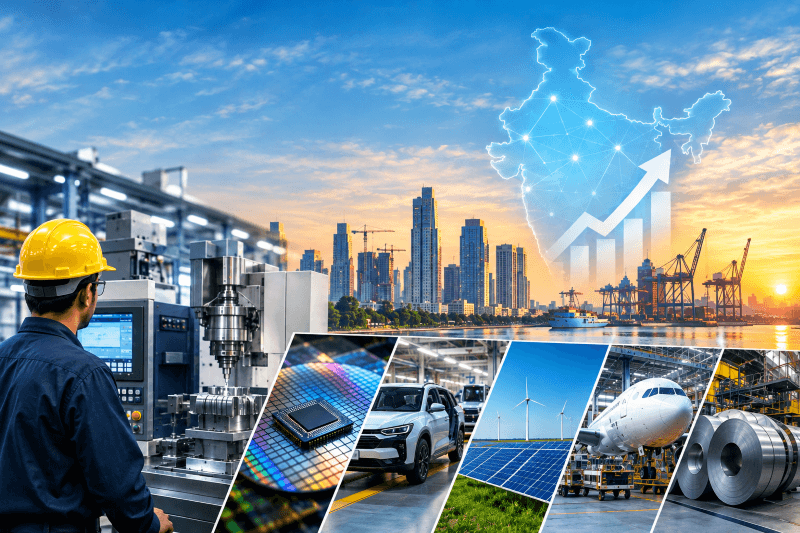
India's manufacturing sector continued to attract investment across semiconductors, automotive production, aerospace, renewable energy, metals, and industrial machinery in 2026, even as some near-term economic indicators showed signs of moderation.
India's real gross domestic product (GDP) grew 7.8% from April through June, supported by an 11.9% increase in investment and a 12% rise in exports, according to figures cited in the industry report. July's Index of Industrial Production (IIP) increased 6.7% year over year, with manufacturing output rising 7.3% and electricity and gas production increasing 8.7%.
Capital goods recorded particularly strong growth, increasing 16.1%. Electrical equipment, motor vehicles, and machinery were among the stronger-performing segments.
However, India's manufacturing Purchasing Managers' Index (PMI) eased to 52.8 in August, its lowest reading in five years. New orders and output growth moderated, while factory employment declined marginally for the first time in 30 months. Input cost inflation also eased, and business confidence remained positive.
Despite the moderation, investment announcements across multiple industrial sectors indicate continued efforts to expand domestic production capabilities and strengthen India's role in global manufacturing supply chains.
Semiconductor and Electronics Investment Expands
India's semiconductor strategy is broadening beyond fabrication and assembly to include equipment manufacturing, materials, chemicals, substrates, and precision electronics.
The country's $13.5 billion Semicon 2.0 program attracted approximately $12 billion in new investment proposals by September, according to the report. The proposals cover semiconductor equipment, materials, gases, chemicals, and substrates, with nearly 100,000 jobs projected.
Applied Materials plans to invest $5 billion over the next decade in research and development, equipment manufacturing, supply-chain development, and workforce expansion. Karnataka is expected to be a major location for these activities. A separate $3.9 billion memorandum of understanding covers semiconductor equipment manufacturing and R&D at Bengaluru Signature Business Park.
Lam Research also plans to establish semiconductor equipment manufacturing capabilities in India, potentially expanding the country's participation in the global semiconductor equipment supply chain.
Tata Electronics and Nexperia have entered a partnership covering wafer manufacturing, assembly, and testing. Under the arrangement described in the report, power-control chips would be manufactured at Dholera and packaged at Tata's Assam facility. Such components serve automotive, industrial, and power-electronics applications.
India's Electronics Components Manufacturing Scheme (ECMS) also expanded in August, adding 31 projects and bringing total approvals to 106. Cumulative committed investment reached approximately $7.9 billion. Approved projects include display modules, printed circuit boards, camera components, and other electronics components.
These developments could increase demand for precision machining, semiconductor production equipment, automation, inspection, and other advanced manufacturing technologies.
Automotive and Electric Vehicle Manufacturing
Investment in India's automotive industry continues across established component suppliers and electric vehicle manufacturers.
Tamil Nadu signed 97 investment agreements in August with a combined value of approximately $7.05 billion, covering automotive, renewable energy, electronics, data centers, and aerospace. Automotive projects accounted for about $1.79 billion.
Automotive component manufacturer Spark Minda announced a $133 million investment in two new manufacturing facilities in Uttar Pradesh's YEIDA region. The plants are expected to produce ignition switches, steering locks, and mechatronic components and create approximately 6,440 jobs.
Electric vehicle manufacturer Ultraviolette plans to invest $82 million in an EV manufacturing plant in Hosur, Tamil Nadu. The facility is expected to have an initial annual production capacity of 250,000 vehicles, with potential expansion to 500,000 units.
Growth in electric vehicle production is also supporting investment across related industries, including battery manufacturing, electric motors, charging systems, power electronics, and component production.
For machine-tool and manufacturing technology suppliers, these developments represent potential demand for CNC machining, robotics, automated production lines, testing equipment, metrology, and precision manufacturing systems.
Aerospace and Defense Manufacturing Developments
India is continuing efforts to expand domestic aerospace and defense production and increase the participation of local suppliers in international programs.
Tata Boeing Aerospace delivered its 400th India-manufactured Apache helicopter fuselage from its Hyderabad facility, according to the report. The milestone highlights the role of Indian manufacturing operations in producing aerospace structures for global programs.
Tata Advanced Systems also signed an agreement with the Javelin joint venture to consider potential co-production of missiles.
Meanwhile, India's Ministry of Defence issued its sixth Positive Indigenisation List, covering 405 items across helicopters, fighter aircraft, armored vehicles, warships, and missile systems. The report estimates approximately $34 million in potential business for Indian suppliers and micro, small, and medium-sized enterprises (MSMEs).
Technology-transfer initiatives from the Defence Research and Development Organisation (DRDO), along with expanded access to testing facilities, are also intended to support domestic technology development.
Aerospace and defense manufacturing requires specialized production capabilities, including multi-axis machining, composite materials processing, additive manufacturing, tooling, metrology, and precision inspection.
Renewable Energy and Critical Materials
Investment in solar manufacturing and battery-related materials is another area of industrial expansion as India works to develop more domestic production capacity for clean-energy technologies.
Agastya Green Energy announced an $816 million plan for a 12-gigawatt solar ingot and wafer manufacturing facility in Andhra Pradesh.
Shakti Pumps is developing a 2.2-gigawatt solar cell and module manufacturing facility in Madhya Pradesh, according to the report.
Battery materials and recycling company Lohum is targeting $315 million in fundraising to expand nickel production alongside lithium and rare-earth processing.
These projects address different stages of the clean-energy supply chain, from solar material production to the processing of materials used in batteries and other technologies.
The investments could create additional requirements for process equipment, material handling, automated production, quality control, and specialized manufacturing systems, depending on project implementation and production needs.
Steel, Aluminum, and Industrial Machinery
India's metals industry is also seeing investment aimed at increasing capacity and supplying downstream manufacturing sectors.
Jindal Stainless plans to invest $102 million to expand cold-rolling capacity at facilities in Hisar, Kharagpur, and Jajpur. The additional capacity is intended to serve automotive, appliance, food-processing, and industrial markets.
Lloyds Metals is expanding its direct-reduced iron operations in Maharashtra as India continues to develop domestic steelmaking capacity.
One of the largest industrial proposals described in the report is an approximately $11.5 billion integrated aluminum project involving Adani and IHC in Odisha. The proposed development includes an alumina refinery, aluminum smelter, captive power generation, and downstream manufacturing.
The project forms part of a broader $25 billion Adani–IHC investment package covering 14 projects in Odisha across renewable energy, healthcare, and industrial development.
Large-scale metals projects typically require a range of industrial equipment, processing systems, material-handling technologies, and maintenance capabilities. Downstream production may also support demand for metalworking machinery and precision manufacturing equipment.
Chemical and Medical Manufacturing Investments
Additional projects in chemicals and medical manufacturing point to continued efforts to localize industrial inputs and finished products.
BASF has secured industrial land at Dahej, Gujarat, while evaluating a potential production complex for methylene diphenyl diisocyanate (MDI), a chemical used in polyurethane applications such as insulation, refrigeration, and automotive components. The proposed investment remains subject to feasibility studies and approvals.
Medical products manufacturer Ansell is investing $60 million in a surgical-glove manufacturing facility in India to serve domestic and export markets.
These developments illustrate the range of industries contributing to India's manufacturing investment pipeline. They also highlight potential requirements for process control, production automation, material handling, and quality-assurance technologies.
Industrial Corridors Support Regional Manufacturing Growth
India's industrial development is also being supported by plans for new manufacturing and infrastructure hubs.
The National Industrial Corridor Development Corporation has identified 20 industrial smart cities across 13 states, representing approximately $61 billion in potential investment, according to the report.
Manufacturing investment is distributed across several regions. Gujarat and Maharashtra are attracting electronics and industrial projects, while Tamil Nadu continues to expand automotive and renewable-energy manufacturing. Karnataka is developing semiconductor equipment and aerospace capabilities, Andhra Pradesh is attracting solar-material investments, and Uttar Pradesh is adding electronics and automotive-component capacity.
The development of industrial corridors may support manufacturing through improved infrastructure and the concentration of suppliers, production facilities, and related services. The scale and timing of resulting opportunities will depend on project execution and the pace at which planned investments move into production.
Outlook for India's Manufacturing Sector
India's economic indicators present a mixed near-term picture. GDP and industrial production recorded strong growth, and capital goods outperformed the broader industrial production index in July. At the same time, the August manufacturing PMI indicated slower growth in orders and output.
Investment announcements across semiconductors, electric vehicles, aerospace, renewable energy, metals, chemicals, and medical manufacturing suggest that companies and government initiatives are continuing to pursue greater domestic production capacity.
For machine-tool manufacturers and advanced manufacturing technology suppliers, the potential opportunities extend across CNC machining, metal cutting, robotics, automation, additive manufacturing, metrology, tooling, semiconductor equipment, and production systems.
Whether these plans translate into sustained equipment demand will depend on project approvals, investment execution, production schedules, and broader economic conditions. Nevertheless, India's efforts to expand its industrial base and develop domestic supply chains make the country an important market to monitor as global manufacturers evaluate production capacity and sourcing strategies.
Oct 12, 2026
